

6,000 consumers
More than 6,000 consumers have already downloaded our app and now have access to information about the impact of the beef they eat.
More than 70% of the beef linked to deforestation in the Amazon and the Cerrado is consumed inside Brazil.
The beef that reaches Brazilian consumers travels a long path, and at every stage there are socio-environmental challenges not mentioned on the product packaging. Understand how this supply chain works and take part in a collaborative effort for a deforestation-free cattle sector.
At the end of the chain is the consumer. And this is exactly where the cycle can change. Anyone who knows where their beef comes from has the power to push the whole chain, in a practical way, with a single scan.
Key numbers:
6,000 consumers
More than 6,000 consumers have already downloaded our app and now have access to information about the impact of the beef they eat.
25,000 products
More than 25,000 products have already been looked up across more than 400 municipalities in every Brazilian state.
What dPaP does:
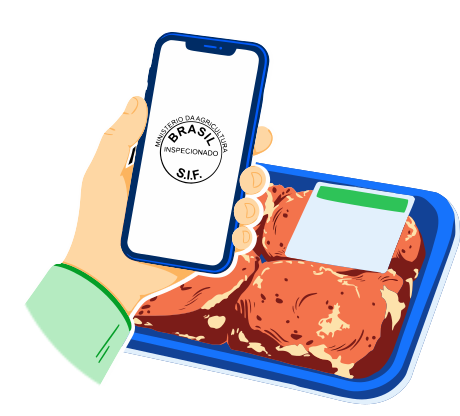
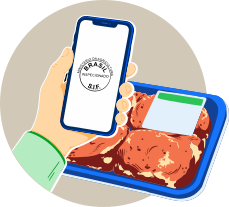
By scanning a product's sanitary code or the meatpacker's CNPJ (company tax ID) in the do Pasto ao Prato app, you get data on deforestation, fire hotspots, slavery-like labor and food safety performance.
Retailer are the last link before the consumer and play a strategic role in the sustainability of the sector. By choosing which meatpackers stock their shelves, supermarkets have the power to encourage more responsible practices along the supply chain.
Key numbers:
97%
97% of the largest retailers in Brazil have no corporate policies to curb deforestation in their beef chain, according to Radar Verde data.
3 retailers
Across the entire Brazilian retail sector, only Assaí, Carrefour and GPA run social and environmental audits on their direct supplier farms, and the practice is still restricted to specific biomes (such as the Amazon and the Cerrado).
The challenge:
Cattle ranching is the main driver of deforestation in Brazil, with deforestation-linked beef sold across Brazil. Retailers are in a position to demand traceability from the meatpackers they buy from, creating real incentives for a more sustainable supply chain.
What dPaP does:
Every time someone records a product at a supermarket through the app, they contribute to a citizen science effort, helping to map where the beef sold by retailers across the country ends up.
Want to help build that map? Every record in the app enriches an open database on Brazilian beef.
The meatpacking plant is where cattle become product. It is also a key point for traceability: every plant has a unique sanitary registration number, such as the SIF (Federal Inspection Service) or another code, that carries the record of where that beef was processed.
Key numbers:
4,072
4,072 meatpacking plants across Brazil, each of which we assessed against social and environmental sourcing criteria, made publicly available in the do Pasto ao Prato app.
2 in 3 cattle in the Amazon
For every 3 cattle slaughtered in the Amazon biome, 2 go through meatpacking plants committed to reducing deforestation, and only 1 through plants with satisfactory performance.
1 in 3 cattle in the Cerrado
For every 3 cattle slaughtered in the Cerrado biome, only 1 goes through meatpacking plants committed to reducing deforestation, and none discloses its performance.
The challenge:
Most of the social and environmental commitments made by meatpackers cover only direct suppliers, the ones that deliver cattle for slaughter. The farms upstream, known as indirect suppliers, are often left out of that monitoring. And it is precisely at those stages that the hardest risks to trace tend to sit.
Worth knowing:
The brand on the packaging does not tell you which plant produced it. JBS, for example, runs more than 50 plants that supply brands such as Friboi, Bordon and Seara. Each plant has a different social and environmental performance. By the same token, competing brands can share the same origin. Plants operating under the same SIF can supply brands like Sadia and Perdigão, which compete on the shelf yet may come from exactly the same place.
What dPaP does:
When you scan the sanitary code on a product, the app identifies the meatpacking plant and shows its social and environmental record.
Try scanning your next purchase. In seconds, you see the social and environmental impacts linked to the plant that processed that beef.
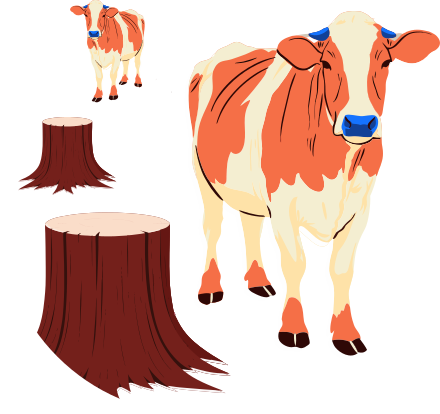
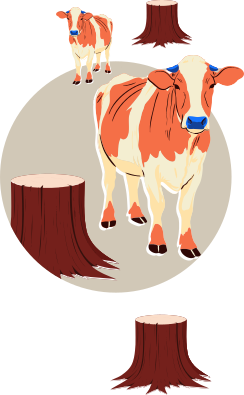
Before it reaches the meatpacking plant, cattle go through different phases: breeding, where calves are born; rearing, where they grow; and finishing, where they gain weight for slaughter. That route can cross several municipalities and states, and this is exactly where the traceability challenges begin.
Key numbers:
3 stages
3 stages are covered by cattle before slaughter: breeding, rearing and finishing - almost always without full traceability.
98%
In 2025, according to MapBiomas, 98% of all deforestation in Brazil was driven by agriculture and cattle farming, and 90% showed some sign of illegality.
30 million
MapBiomas also reports that around 30 million hectares of pasture in Brazil have low forage production and a high share of exposed soil.
The challenge:
Breeding and rearing farms can hide where their cattle came from. Many of them sit in remote areas, which makes enforcement harder. Without traceability in these early stages, practices such as illegal deforestation, slavery-like labor and even cattle laundering stay out of sight, undermining the sustainability and the ethics of production.
What dPaP does:
The app draws on data such as the Animal Transit Guide (GTA) to identify the municipalities the cattle came from. Want to understand how we trace the origin of the herd? Our methodology is open and documented.